
Reproducible release evidence
Windows Shortcut Security Lab
This lab publishes the measured release gates behind Shortcut Remover 8.0.0: labeled shortcut behavior, scale and responsiveness, accessibility checks, artifact identity, and a real Windows drive-root scan. Results are reported with their limits so controlled evidence is not mistaken for a universal malware-detection claim.
Download the evidence CSV Inspect the release manifest
Release identity
- Product version
- 8.0.0
- Build ID
8.0.0-rc-1786773149059- Installer SHA-256
5F01CDDCC013DD1CAD3086BA67A5AA0E2C2989774E1854901165CE7760EBB834- Automated tests
- 327 passed, 0 failed
- Code signing
- Not Authenticode-signed; verify the published hash before use
Controlled labeled shortcut corpus
The release gate contains 310 labeled malicious cases and 600 labeled benign cases. All 310 malicious cases were detected, and all 600 benign cases remained unselected as malicious. No input file was modified or lost during the 2.024-second corpus run.
| Class | Labeled | Correctly classified | Misclassified |
|---|---|---|---|
| Malicious test shortcuts | 310 | 310 true positives | 0 false negatives |
| Benign test shortcuts | 600 | 600 true negatives | 0 false positives |
Scale, pause, and cancellation gate
The controlled NTFS gate exercised 1, 1,000, 10,000, and 100,000 input files. Larger scenarios included deterministic 1% access failures and 1% malformed-shortcut parse failures so accounting could be verified.
| Measurement | Observed value | Scope |
|---|---|---|
| 100,000-file elapsed P95 | 6,922.418 ms | Controlled local NTFS test root |
| 100,000-file throughput P50 | 16,507.253 files/second | Release-test environment, not an end-user promise |
| Peak working set | 71,368,704 bytes | Observed across the gate |
| Cancellation response P95 | 0.4514 ms | Injected-delay harness signaling measurement |
| Pause progress drift | 0 files | 800.2884 ms frozen observation window |
| Residual items | 0 | No test files, directories, or harness workers left behind |
Real drive-root observation
The compiled release candidate performed a separate read-only quick scan of a real D: drive root. It completed naturally in 2 minutes 13.774 seconds and reported 42 directories, 17,486 files, 12 shortcuts, two access errors, zero reparse-point skips, and no safety-limit stop.
The two access errors caused an incomplete result and exit code 3. The product did not present the partial coverage as a clean or complete scan. This observation independently reproduced the corrected volume-root behavior; the earlier 25-millisecond, zero-file failure did not recur.
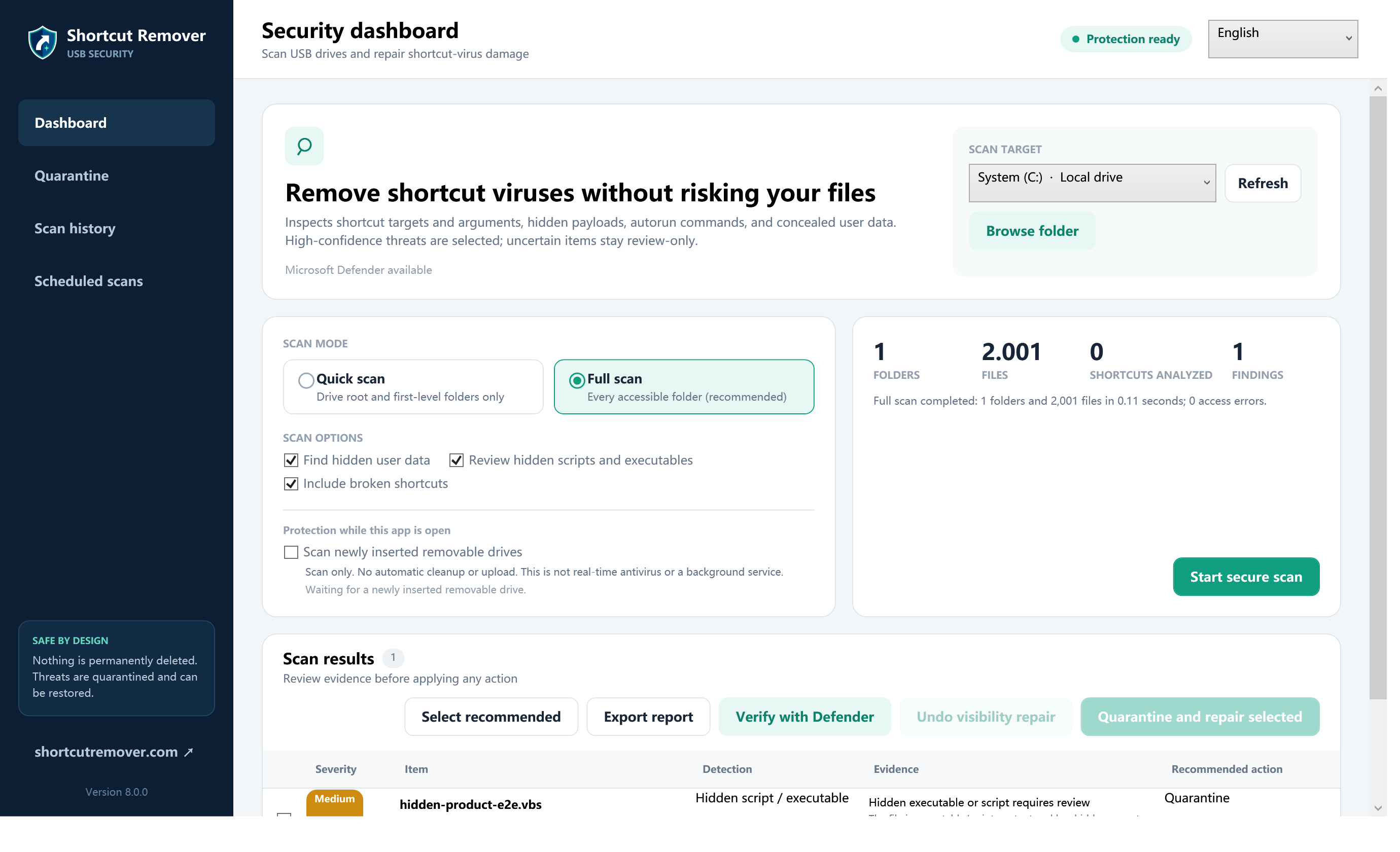
Accessibility and product-level checks
- 48 instrumented product end-to-end checks.
- 5 removable-drive runtime scan product checks.
- 60 window scenarios, 1,537 interactive nodes, and 240 screenshots across 10 languages.
- 0 actionable violations in the automated UI Automation and keyboard gate.
Narrator behavior was not verified in the release environment. Automated accessibility evidence reduces risk but does not replace testing by people who use assistive technology.
Evidence files
- Lab evidence CSV — compact measurements and interpretation notes.
- Release manifest — machine-readable build, test, corpus, scale, accessibility, and artifact data.
- SPDX software bill of materials — release dependency and file inventory.
- Citation File Format record and BibTeX record — stable citation metadata for this version.
- Evidence checksums — SHA-256 values for the public CSV, release manifest, SBOM, and citation records.
- Testing methodology — how each gate works and what it does not prove.
- Version 8.0.0 release notes — user-visible changes and known limits.
Known evidence gaps
- Unattended physical USB scale testing was deferred; the scale gate used a controlled fixed-disk NTFS root.
- The real drive-root observation represents one device and one file population.
- Automated UI checks do not establish complete accessibility for every assistive technology.
- The installer is currently unsigned and may show an Unknown publisher warning.
- No static or behavioral shortcut check can guarantee that every referenced remote resource remains safe later.